
Learning Outcomes
- CO5-RRI-01: Examines and describes the rights and responsibilities of individuals in different contexts
- CO5-GOL-01: Explains the role of government and the law in society
- COLS-GOL-01: Identifies the role of government in Australian society
Syllabus Links
7–10 | Commerce 7–10 Syllabus (2024, implementation 2027)
Topic: Stage 5 – The legal and political environment
Focus: The nature and function of laws
- The differences between laws and non-legal rules
- The reasons for laws in society
- The principles and benefits of the rule of law
- The differences between criminal law and civil law
- Law-making processes, including statute law and common law
- The Customary Lore of Aboriginal and Torres Strait Islander Peoples
- The hierarchy and jurisdiction of state and federal courts
- The reasons for changes in the law
Life Skills
The nature and function of laws
- The definition of a law
- Who laws apply to
- Reasons laws are needed
- Differences between civil and criminal law
- Who makes laws
Why do Laws Change?
Laws are always changing and reflect the morals and values of the society we live in. They are made either through the statutory process or common law. Statute law is made by the Government responding to societal change. Existing laws also change when they require updating or are no longer relevant.
New and existing laws affect our rights and responsibilities and make an impact on all aspects of our lives including future careers and the ways we work.

Did you know?
Debating and approving legislation is a major part of the workload of the parliament. Hundreds of laws are passed each year. In 2019 there were 217 laws reviewed by the Legislation Review Committee and 91 new bills presented to the chambers.
What is Legislation?
Legislation is a document containing rules that have been voted on and approved by the Parliament. It is also known as an Act or statute and tells us what the rules are in the area that it legislates upon.
Where do Laws Begin?
The majority of Acts are initiated by the Government, and their policies may come about from promises the political party took to an election or responses to current situations such as:
- urgent need, like a natural disaster or pandemic
- the media or public opinion pointing out particular needs
- advice from government departments
- from court decisions

When the Government is satisfied that laws are needed, the Minister concerned submits the proposal to the Cabinet for approval and a bill is drafted, usually by the NSW Parliamentary Counsel Office. The party room is where bills will be discussed with all of the party members.
Did you know?
Any member of Parliament can initiate a bill, but many are introduced by Ministers of the Government. A bill can be introduced into either the Legislative Assembly or the Legislative Council.
From Idea to Law
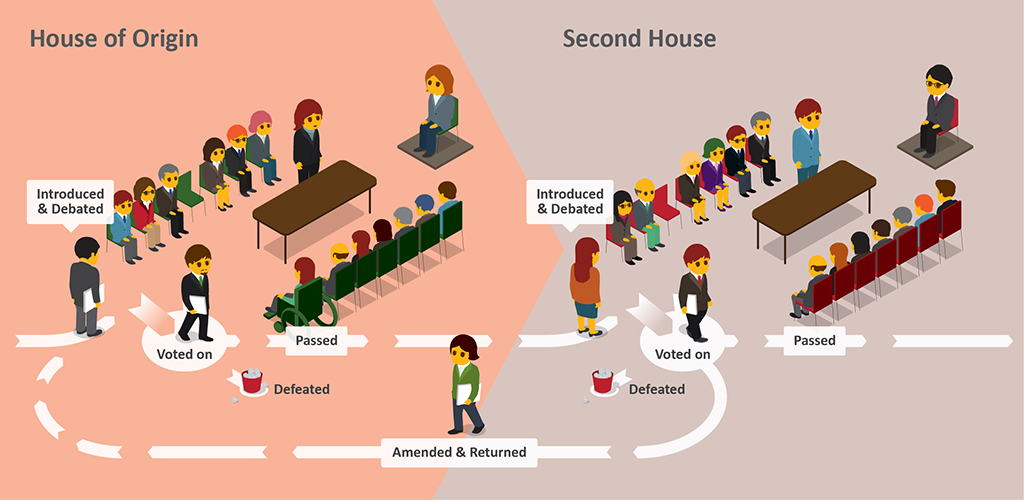
A bill can originate in either the Legislative Assembly or the Legislative Council. It then progresses to the other chamber.
Royal Assent
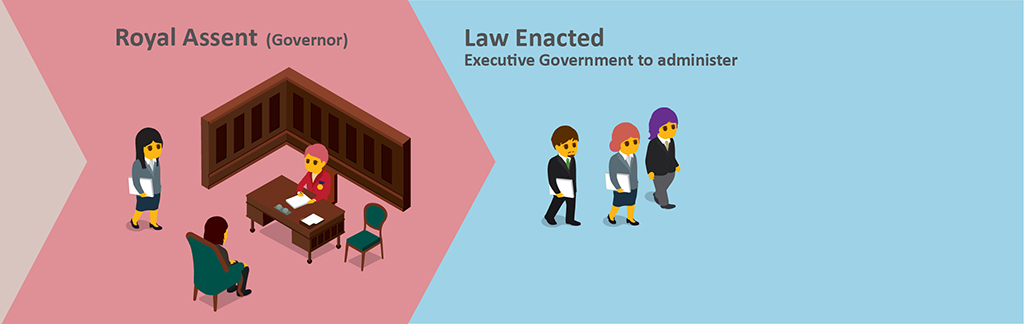
This is the final stage in the process by which a bill becomes an Act. Once it has passed through all stages in both Houses, it is presented to the Governor whose formal approval is required. This is called assent.
When Does a Law Take Effect?
An Act will come into force 28 days after the Governor’s signature unless the Act specifies otherwise. It might be instant or at a later date.

Special Rules About Money Bills
Under Section 5 of the NSW Constitution Act, Money Bills (Bills for raising or allocating money) can only be introduced in the Legislative Assembly and if the Bill is part of the ordinary annual services of Government, the Legislative Council cannot prevent it becoming law.
Summary of the Passage of a Bill
Before a bill is introduced into Parliament the Minister or private member introducing it gives notice of their intention to introduce the bill. Copies of the bill are distributed and published on the Parliament’s website here.
Bills can be introduced in both Houses. In the below example, we will imagine a bill has been introduced in the Legislative Assembly. Once it has gone through three stages, it is forwarded to the Legislative Council.
The Council will also read the Bill in three stages and may agree to the bill without amendment and forward it to the Governor’s assent. However, it may return the bill with amendments for the Assembly’s consideration or it may not pass it.
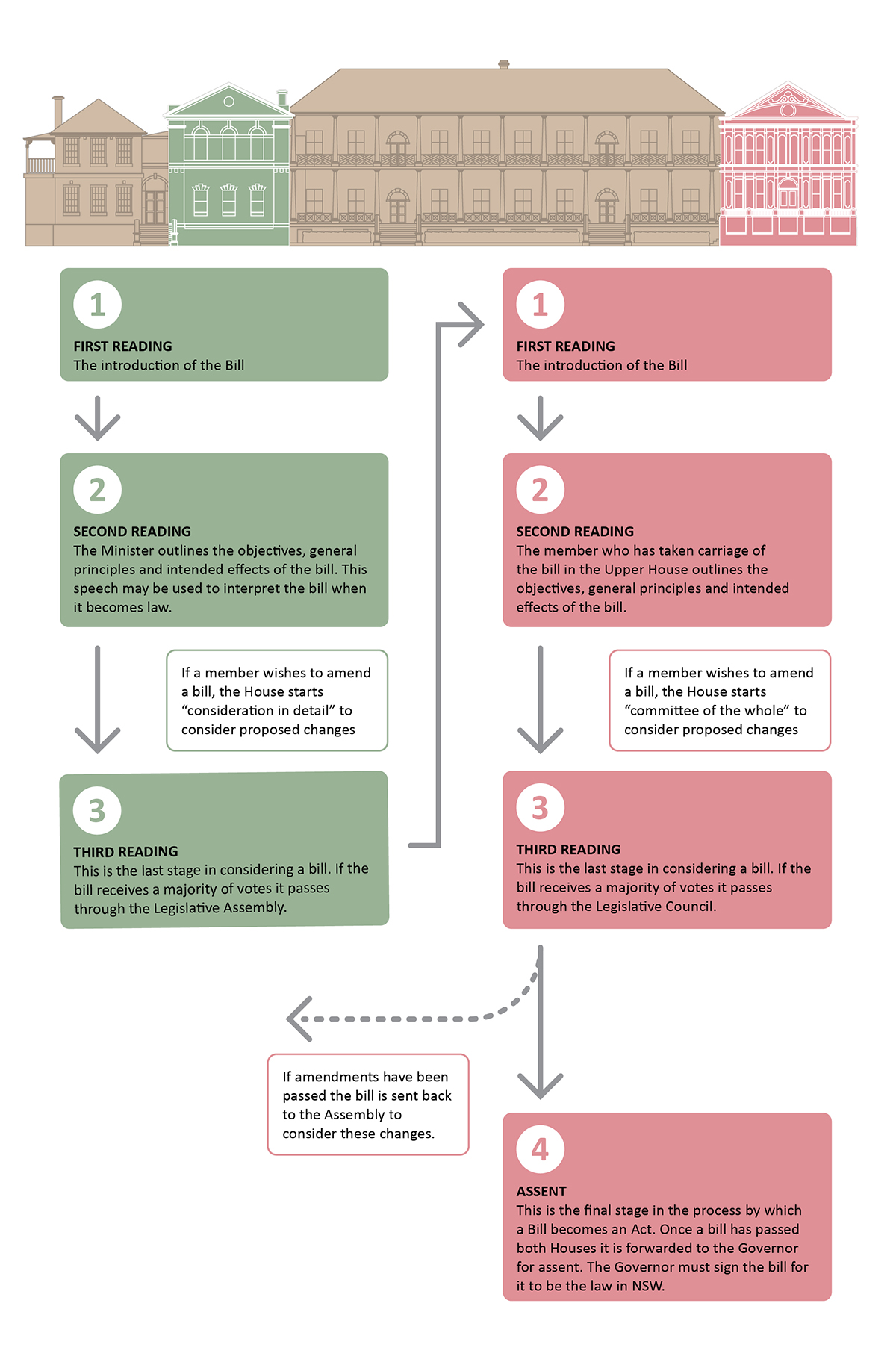
An example of this process is captured by the Legislative Council’s summary of the passage of the Abortion Law Reform Act in 2019 available here.
A more detailed fact sheet is also available here.
Delegated Legislation
Through the authority of an Act of Parliament, Ministers can be handed power to make regulations, statutory rules, by-laws, ordinances, orders in council and various other ‘instruments’ made by the executive to fill in the detail of a law. These are often referred to as delegated or subordinate legislation.
Can an Existing Law be Reviewed?
The law is constantly updated in line with social values, new concepts of justice, and in response to developments in new technologies.
- Some bills have a review mechanism built into them that suggests they should be reviewed by a committee or the Minister after a certain period of time.
- Ministers can also introduce a bill to amend an existing Act and also committees make recommendations to the Government about reform.

Case Study
Real estate agents are bound by law to disclose certain information when selling a property. Section 52 of Property and Stock Agents Act (NSW) 2002 establishes a list of ‘material facts’ that an agent must disclose. Agents have a responsibility to act in ways that treat consumers and the public fairly through disclosure and professional behaviour.
The Act prescribes that material facts must be disclosed to potential buyers including any information about a property that might influence a buyer’s decision in making a purchase and protects them from potential deception – for example, if the house was the scene of a crime.
The law applies to the actions of the agent and non compliance can incur a heavy fine.
These are outlined by the legislation as well as:
- The Property and Stock Agents Regulation 2019 which sets out rules of conduct (both general and specific) that apply to both licensees and certificate of registration holders.
- The Australian Consumer Law (ACL) also applies to the conduct of real estate and property agents.
Helpful Links
|
The Legislation Review Committee’s consideration of the Property Stock and Business Agents Amendment Regulation 2019 |
Available here (pages 49-50) |
|
Section 52 of the Stock Agents Property Act 2002 |
|
|
NSW Fair Trading website gives a detailed guide for Real Estate Agents to ensure they don’t make any misrepresentations to the consumer. |
|
|
Commentary from Real Estate Agents that were directly involved in the sale and resale of the property and how they have dealt with the issue of material facts |