Learning Outcomes
- CO5-GOL-01 explains the role of government and the law in society
Syllabus Links
The legal and political environment (core)
Australia’s political system
- Levels of government and their responsibilities, including the division of powers
- How and why the separation of powers exists between the parliament, executive and judiciary
- Law-making processes, including statute law and common law
The economic environment (core)
The role of government in the economy
- The economic objectives of governments in maintaining a strong economy
- The reasons for government intervention in the Australian economy
- The methods of government intervention in the Australian economy
The NSW Budget Process
The New South Wales (NSW) Budget process is an annual cycle where the government plans its finances, determines funding priorities, and seeks legal authorization from the NSW Parliament to spend public funds. It involves careful drafting by Treasury, legislative approval, and intense public scrutiny.

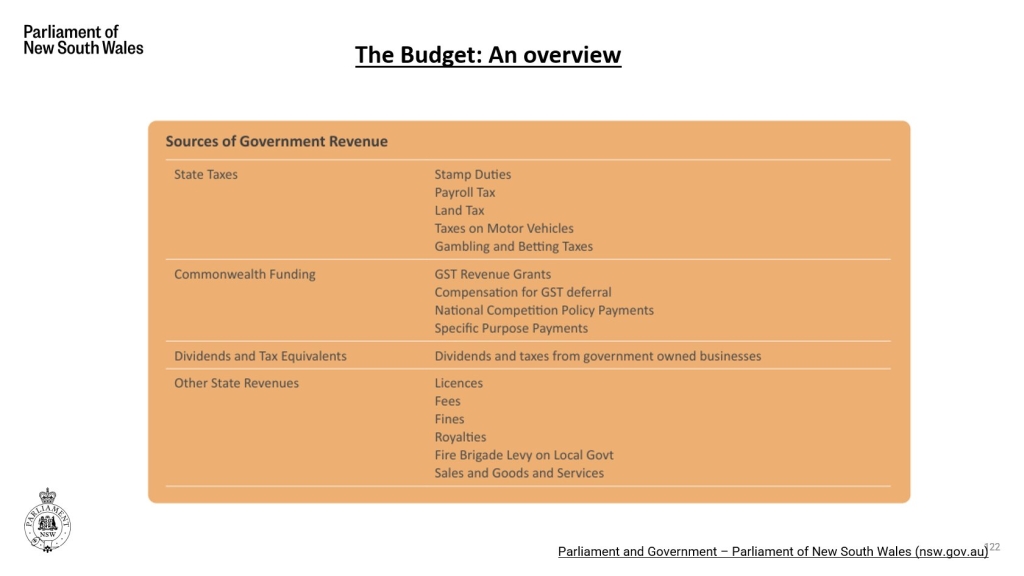
Where does the money for the NSW Budget come from?
Government Revenue
An important part of the Budget process is the raising of revenue. The budget is the Government’s plan of how to spend this revenue.
The money for the NSW Budget comes from a combination of state-collected taxes, federal funding (mainly collected from income tax and GST), and various other revenue streams. In 2026 – 2027, for example, the NSW Government anticipated a total general Government revenue of 130.7 billion.
- The NSW Government raises approximately 40% of the money for the Budget from state taxes such as stamp duty, payroll tax, and gambling taxes.
- The Goods and Services Tax (GST) is collected by the Australian Federal Government and then distributed to the states and territories. This makes up almost a quarter of the State Budget’s revenue.
- About 25% for the annual state budget also comes from Federal Government Grants given to NSW by the Federal Government for specific programs like healthcare and infrastructure.
- The rest of the money comes from a variety of sources including the sale of government goods and services, mining royalties, interest on investments, dividends from state-owned corporations, and various fines or fees.
Please note: these are approximate amounts that may change year by year but tend to remain constant as a proportion of annual Government revenue.
1. Planning and Drafting (The Executive)
- Agency Proposals: Government agencies submit their financial data, including actual spending to date and future projections, to NSW Treasury.
- ERC Deliberations: The Expenditure Review Committee (ERC) of Cabinet reviews these bids and decides on funding priorities, spending, and savings targets. Annual Budget process
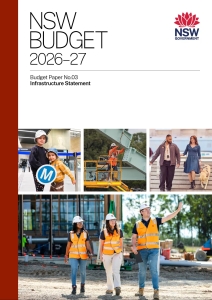
- Drafting the Budget: Once ERC decisions are locked in, Treasury drafts the state budget, which typically includes the Treasurer’s Budget Speech and the four main Budget Papers ( Budget Statement, Agency Financial Statements, Infrastructure Statement, and Appropriation Bills).
2. Budget Day and Introduction to Parliament
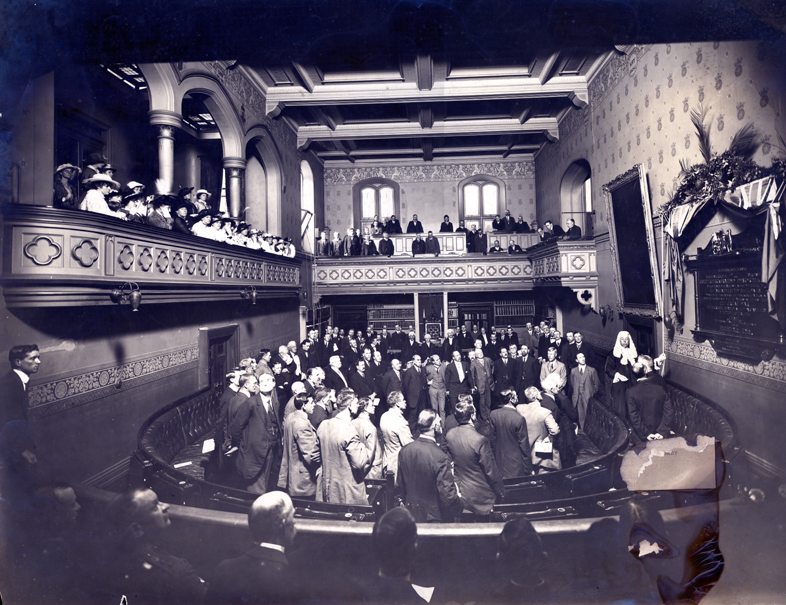
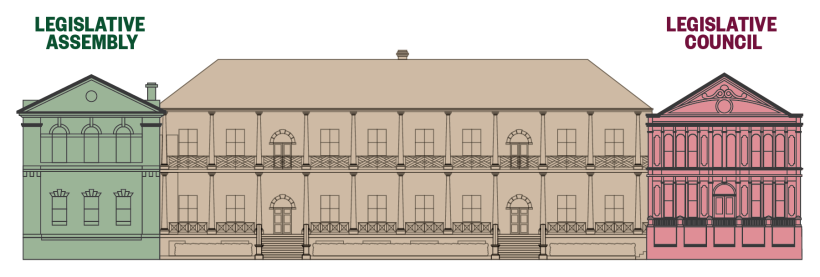
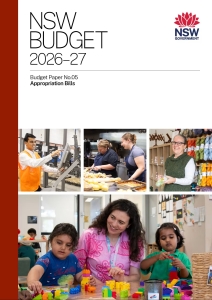
- Budget Speech: This is when the Treasurer tables the Budget Papers and introduces the annual Appropriation Bills in the Legislative Assembly (the lower house). By law, money bills must originate in the Legislative Assembly before going to the upper house. The Legislative process explained,
- Watch the NSW Treasurer’s Budget Speech
- The Bills: The Appropriation Bills outline exactly how much money is allocated to each Minister and the specific purpose for which it is intended. They are also called Money Bills.
3. Passing the Bills
-
Money Bills or Appropriation Bills are Government bills that propose a tax or the spending of money for a particular purpose. They can only be introduced in the Legislative Assembly. After they are introduced, they follow the same passage through both Houses as other bills
-
Debate and Approval: Under section 5A of the Constitution Act 1902, the Legislative Assembly may direct that any bill appropriating revenue for the ordinary annual services of the Government may be presented to the Governor for assent where that bill has been rejected, not passed, or amended, by the Legislative Council without the final agreement of the Legislative Assembly. This is also called the Override Power.
- Royal Assent: Once approved by both houses, the bills are sent to the Governor of NSW for Royal Assent, at which point they become Acts and the government is officially authorized to spend the allocated funds. These appropriations under the annual Appropriation Act takes effect from 1 July and lapse after the end of the financial year (30 June).
4. Parliamentary Scrutiny & Budget Estimates
After the Appropriation Bills, and the Bills are passed by both Houses are officially passed, the NSW Parliament rigorously scrutinizes the budget:
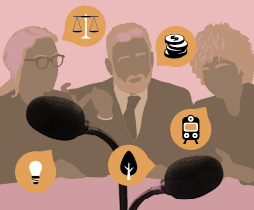
- Budget Estimates: The Legislative Council’s (upper house) seven Portfolio Committees conduct in-depth inquiries into the proposed budget. Ministers and senior public servants attend these annual public hearings at Parliament House to answer detailed questions about their agency’s expenditures, performance, and policy decisions.
- Parliamentary Committees, such as these, are a subset of Members of Parliament that come together to inquire into topics and issues. In this case, the NSW Budget.
5. Implementation and Accountability
- Execution: Government agencies execute their budgets throughout the financial year.
- Monitoring: Agencies continuously report to Treasury, which tracks the actual spend against projected targets and legislated consolidated reporting requirements.
- Ongoing Audits: Independent oversight bodies, such as the Audit Office of NSW, continuously monitor government expenditure to ensure transparency and accountability. More on public accountability

FIND OUT MORE
LINKS: Overview of the NSW Budget process, including Key Budget Charts and the Budget Estimates process.